Use Case: Tropical Nights and Cooling Demand Analysis
This notebook explores how increasing temperatures affect nighttime heat stress and the demand for cooling. We use earthkit-climate to compute tropical nights and cooling degree days, analyzing their trends and correlation.
We use:
``tropical_nights``: Number of days where \(T_{min} > 20^{\circ}C\).
``cooling_degree_days``: Cumulative degrees above a comfort threshold (\(18^{\circ}C\)).
The workflow includes loading temperature data, computing indices, performing trend analysis, and visualizing the relationship between the two indicators.
[ ]:
import warnings

import earthkit.data as ekd
import earthkit.plots as ekp
import matplotlib.pyplot as plt

import earthkit.climate as ekc

warnings.filterwarnings("ignore")
plt.rcParams["figure.figsize"] = (12, 6)
Loading Data
We load historical daily minimum temperature (tasmin) from CMIP6 simulations. We will use tasmin also as a proxy for tas to calculate cooling degree days if tas is not available, or just focus on minimum temperature trends if preferred. Here we load tasmin to compute tropical nights.
[ ]:
ds_tasmin = ekd.from_source("earthkit-climate-sample", "tasmin_ACCESS-CM2_historical_reference").to_xarray()
Computing Indices
We compute the indices on an annual basis. For demonstration, we’ll use tasmin for both, noting that cooling_degree_days usually uses tas.
[ ]:
# Compute annual tropical nights
tn = ekc.indicators.tropical_nights(ds_tasmin.tasmin, thresh="293.15 K", freq="YS")

# Compute annual cooling degree days (using tasmin for this example)
cdd = ekc.indicators.cooling_degree_days(ds_tasmin.tasmin, thresh="291.15 K", freq="YS")
Trend Analysis
We estimate the trend for both indicators over the available period.
[ ]:
# Simple linear trend using xarray's polyfit
tn_trend = tn.polyfit(dim="time", deg=1).polyfit_coefficients.sel(degree=1) * 1e9 * 60 * 60 * 24 * 365 * 10
cdd_trend = cdd.polyfit(dim="time", deg=1).polyfit_coefficients.sel(degree=1) * 1e9 * 60 * 60 * 24 * 365 * 10
Visualization
Trend Maps
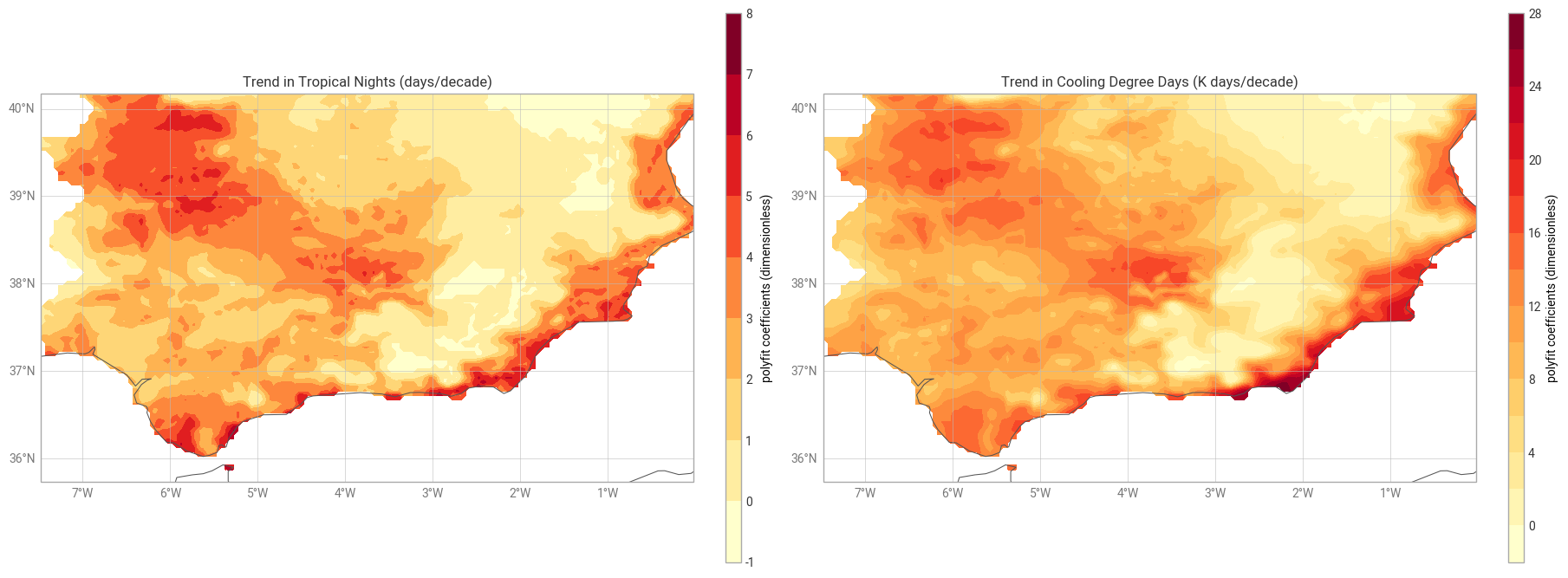
We visualize the spatial patterns of trends in tropical nights and cooling degree days.
[ ]:
figure = ekp.Figure(rows=1, columns=2, size=(18, 8))

ax1 = figure.add_map(row=0, column=0)
ax1.quickplot(tn_trend, style=ekp.styles.Style(colors="YlOrRd"))
ax1.coastlines()
ax1.gridlines()
ax1.title("Trend in Tropical Nights (days/decade)")
ax1.legend(location="right")

ax2 = figure.add_map(row=0, column=1)
ax2.quickplot(cdd_trend, style=ekp.styles.Style(colors="YlOrRd"))
ax2.coastlines()
ax2.gridlines()
ax2.title("Trend in Cooling Degree Days (K days/decade)")

ax2.legend(location="right")

figure.show()
Correlation Analysis
Finally, we analyze the relationship between tropical nights and cooling demand by plotting their correlation over time.
[ ]:
# Aggregating spatially for a simple correlation plot
tn_mean = tn.mean(dim=("lat", "lon"))
cdd_mean = cdd.mean(dim=("lat", "lon"))

plt.scatter(tn_mean, cdd_mean)
plt.xlabel("Average Annual Tropical Nights")
plt.ylabel("Average Annual Cooling Degree Days (K days)")
plt.title("Relationship Between Nighttime Heat Stress and Cooling Demand")
plt.grid(True)
plt.show()
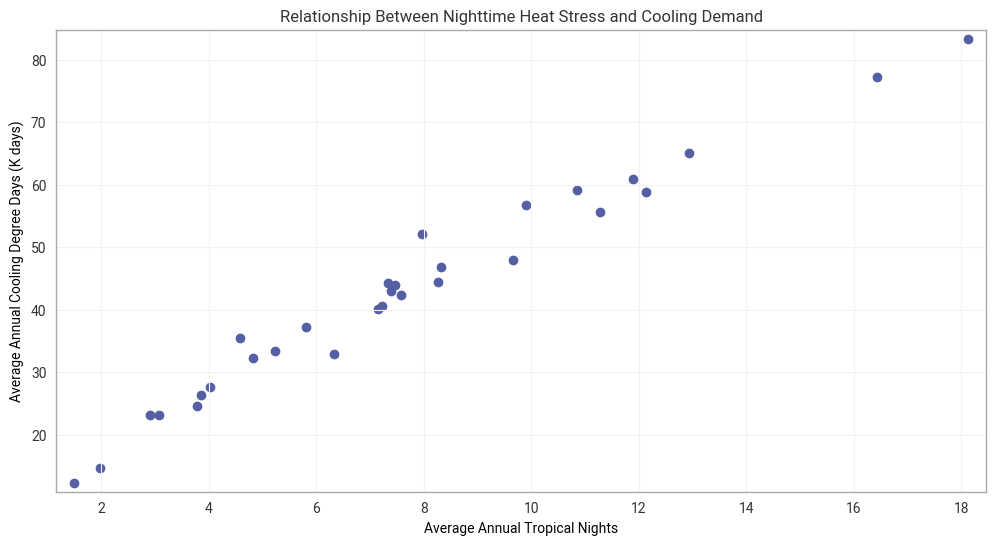
The results confirm a sustained anthropogenic warming trend across the southern Iberian Peninsula, with an increase of up to 8 tropical nights per decade in coastal areas and the Guadalquivir Valley. The strong linear correlation observed in the scatter plot demonstrates that rising nighttime minimum temperatures are a critical driver of energy demand: as nights lose their capacity to naturally cool the environment, the Cooling Degree Days (CDD) index increases proportionally. This scenario suggests that, if current trends persist, the region will face not only public health challenges due to thermal stress but also growing pressure on electrical infrastructure and household economic sustainability due to a heightened reliance on air conditioning.